


A Goose Creek woman — let’s call her “Terri” — says her family might not have any money left over for Christmas shopping this year. But she’s trying to stay positive.
“Right now, we’re really just hoping and praying,” said Terri, who asked to remain anonymous in an interview as temperatures this week flirted with freezing. “We don’t know what’s going to happen, so we have to just trust that we will have something. And that’s thanks to this organization and others that are banding together and giving their time, standing out in the cold with us.”
She sat on the concrete steps of Second Chance Recovery’s food pantry one early morning, braving the weather and busy traffic on foot, pushing a small cart to collect whatever donations could be given.
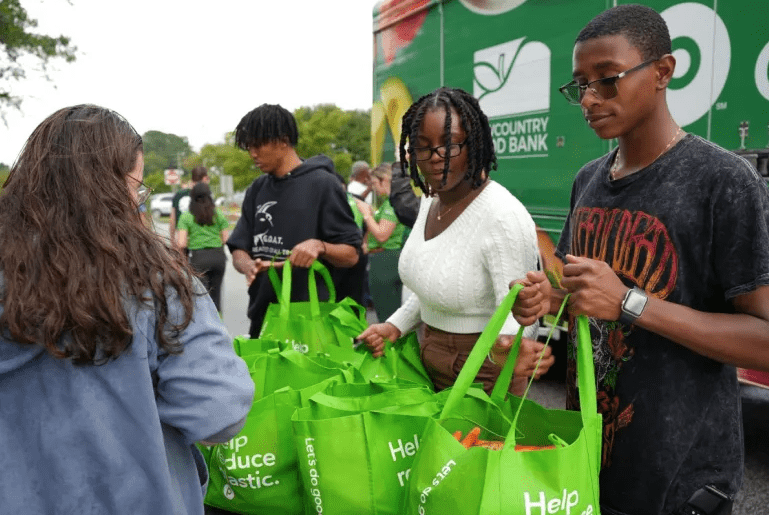
Terri isn’t alone, as dozens line up behind her or park in their cars each week to get food for themselves and their families.
Several pantries that partner with the Lowcountry Food Bank see similar turnouts every day that they are open. And in many cases, after only 15 minutes of distribution, the pantries have given away all they have for the day. But those who line up early — often half an hour before the pantry opens — are grateful for what they get.
“They’re wonderful workers and volunteers,” Terri said. “They give us fresh vegetables, fruit, bread and even sweets. And this is just one pantry that really helps and really does the right thing by their community.”
The Lowcountry Food Bank gets food and other donations from several sources, including retail and grocery partners and community organizations. That then gets loaded up every day and sent to 240 different partner agencies and food pantries across 10 counties.
Holidays around the corner
With the holidays quickly approaching, folks in line at the pantries are looking forward to just their next meal, as opposed to Christmas shopping and holiday lights.
Though most people at the pantry line up in their vehicles and help volunteers load up the trunks, one man who we’ll call “Mark,” walks from his nearby home with a little red wagon.
“I’m disabled, and I get a check every month, but it doesn’t last,” he said. “This food helps me make it through one week to the next. For Christmas this year, I’ll be happy just to get a turkey.”
Davis said she often lets Mark cut to the front of the line, rather than make him sit in his own wagon surrounded by dozens of exhaust pipes. Volunteers on Wednesday gave him an extra pack of sweets for his birthday this weekend.
Jill Hirsekorn, the food bank’s spokesman, said more people than ever are seeking food assistance due to the record-setting government shutdown and the slashes to government benefits.
“We are seeing many folks during this government shutdown who are seeking food assistance for the first time,” Hirsekorn told the Charleston City Paper. “We are definitely seeing a significant rise in the number of neighbors who visit our Charleston and Myrtle Beach facilities to obtain an emergency bag of food to take home.”
Over the last year, the need for food assistance has risen by 30%, according to Lowcountry Food Bank CEO Nick Osborne. In 2024, the food bank supported more than 200,000 residents, distributing more than 46 million pounds of food, the equivalent of 33 million meals. In October, however, walk-ins at the food pantry tripled, and web page traffic more than doubled.
A big part of that was the loss of the federal Supplemental Nutrition Assistance Program (SNAP).
“The shutdown has really impacted everybody in some kind of way or another — working or non-working,” Terri said. “It’s not just about one person. It’s people who are working poor or living paycheck to paycheck. … Many of the people who are receiving benefits are disabled.
“If they pay their rent, they don’t have enough money left over for food. That’s who these benefits are for.”
Help on the way
According to the Coastal Community Foundation, to meet the current demand due to the loss of the federal SNAP funding, the Lowcountry Food Bank must add at least $125,000 in food assistance every week. That’s why the foundation activated its Care Fund Nov. 4.
The Care Fund seeks to bolster community outreach with flexible, rapid-response funding in response to different crises. Last week, the foundation set a goal to raise $500,000 for the Lowcountry Food Bank through The Care Fund. In just the first day, the foundation raised $340,000. As of Nov. 12, that total increased to $411,000, with about $71,000 coming from individual community donations.
“We are proud of the way the community has stepped up to support our region through The Care Fund,” Darrin Goss Sr., the foundation’s president and CEO, told the City Paper. “The fund is essential to counter the hardships caused by a loss of federal funding and a significantly increased need. We are hearing from our nonprofit partners that if the shutdown ended today, they expect it will take several weeks to return to a level of normalcy.”
On Nov. 12, the Duke Endowment announced a gift of $1 million toward Feeding the Carolinas, the association of food banks in North and South Carolina, in response to the rising demand following disruptions to federal assistance. The funds will be divided among the 10 associated food banks based on the levels of food insecurity of the geographic areas they serve.
If you want to help: coastal.fcsuite.com/erp/donate. All donations go directly toward recipients of the grant funding, as CCF and the Lowcountry Food Bank collect no fees from the fund.
If you need help: lowcountryfoodbank.org. Visit the Lowcountry Food Bank website to find the nearest partner pantry to you.
About the Lowcountry Food Bank: Feed. Advocate. Empower.
The Lowcountry Food Bank serves the 10 coastal counties of South Carolina and distributed more than 45 million pounds of food in 2024. The Lowcountry Food Bank helps fight hunger by distributing food to nearly 240 partner agencies including on-site meal programs, homeless shelters, and emergency food pantries. The Lowcountry Food Bank advocates on behalf of those who experience food insecurity and helps empower people to make healthy and nutritious food choices. For more information, visit the Lowcountry Food Bank website.
Recent Comments