


CHARLESTON — November 29, 2025 — Between May and September, the Lowcountry Food Bank lost out on 21,384 gallons of milk and 33,750 one-dozen cartons of eggs.
The nonprofit, which serves 10 coastal communities, was one of four South Carolina food banks that didn’t receive 1.5 million pounds of food from the U.S. Department of Agriculture during that time. They didn’t get the pallets of meat, dried fruit and cheese they often rely on for people in need.
For the Lowcountry Food Bank, the loss amounted to 615,787 pounds. Nationwide, 94 million pounds of federal food aid that was expected this summer never arrived.
Starting in the spring, the Trump administration canceled $500 million from the USDA’s Emergency Food Assistance Program that sends dairy, meat, eggs and produce to food banks, roughly one-fourth of the program’s funding last year, according to ProPublica.
According to Brenda Shaw, Lowcountry Food Bank’s chief development officer, what comes from the USDA typically equates to $12 million and feeds roughly 167,000 people, she said.
The Emergency Food Assistance Program, which was established by Congress in 1983, received additional aid under the Biden administration to address post-pandemic supply chain challenges. Starting this spring, the program experienced significant cuts.
“While the Biden-era TEFAP slush fund was terminated, the program continues to operate uninterrupted, as originally intended by Congress, with more than $394 million spent in recent months to connect families with food,” a USDA spokesperson wrote in an email.
During fiscal year 2025, USDA announced $939 million in available fruits, vegetables, and other commodities, made possible through Section 32 purchases, which will go directly to food banks and other charitable organizations, according to the statement.
But along with cuts to TEFAP, Lowcountry Food Bank has also experienced strains from the elimination of other programs that allowed it to purchase from local farmers and a reduction of bonus allocations from the USDA, said Shaw.
The cuts to federal food assistance programs have occurred while food insecurity is on the rise. Over the past year, the need for food assistance has risen by 30 percent in many parts of Lowcountry Food Bank’s service area, said CEO Nick Osborne.
The monthlong government shutdown that brought furloughs and delayed paychecks, coupled with deferred SNAP benefits, only exacerbated the strain on food pantries. Some pantries reported a two-fold increase in clients during the government shutdown, many of whom had not sought food assistance previously.
Though the government shutdown has ended, community efforts continue to address the ongoing crisis. Partnering grocery stores, churches and volunteer groups have stepped up to provide more food to local pantries, but the loss of federal support adds strain to these groups at a time more people are finding it increasingly difficult to put food on their tables.
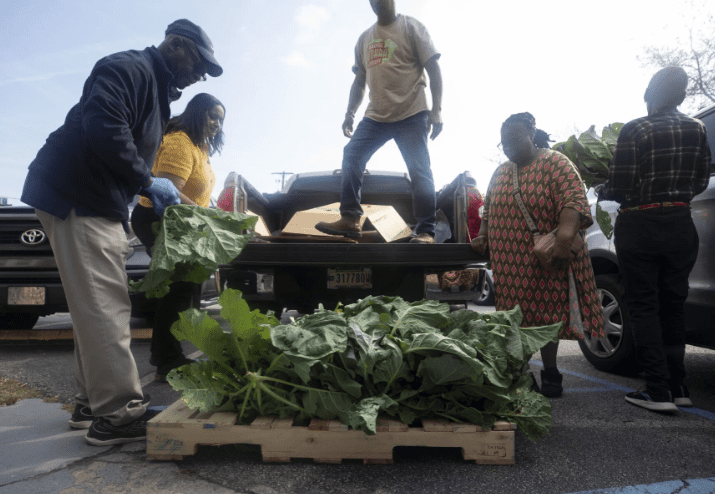
On Nov. 20, a truck with a pallet full of freshly picked collards arrived in the parking lot of Morris Brown AME Church in Charleston. As volunteers unloaded the delivery from Ridgeville Okra Company, dozens of people filtered into the church on Morris Street.
Inside, they lined up with paper bags and grocery totes in a tight hallway. Church members handed out produce and pantry staples in a fast-paced food giveaway the week before Thanksgiving.
Rodney Simmons lives near the church and heard about the giveaway from a neighbor. He works as a dishwasher at a nearby hotel. The work isn’t always steady, he said. The hours are on and off, and times are tough.
“Everybody needs a little help,” Simmons said. “Everybody’s struggling these days, but we gotta hope for the best.”
Carol Johnson picked up a bunch of collards. She said she prepares her greens with smoked meat. As a senior on a fixed income, she relies on other resources for food, like the giveaway at the church.
“It helps a great deal,” she said.
Morris Brown Pastor James Keeton said the church organized the food giveaway in response to the record-setting government shutdown ahead of the holidays.
“We had a number of people, even in our congregation, who had been furloughed, and some of them are still waiting on compensation from the government shutdown,” Keeton said. “We wanted to try to have fresh produce so that people could be able to provide for their families and try to ensure that we will have a great Thanksgiving.”
Local partnerships make up the difference
Over the past year, local food banks and pantries have increasingly needed to replenish the hole left from missing food aid that typically comes from the federal government.
At Lowcountry Food Bank, about 30 percent of the nonprofit’s food comes from the USDA, Shaw said. Another 30 percent comes from retail partners, such as grocery stores, according to the food bank’s 2024 annual report. Farms provide 18 percent of the supply and the food bank purchases another 10 percent. Six percent comes from local donors.
Along with the reductions to The Emergency Food Assistance Program, cutbacks to other federal programs have affected the food bank’s operations. The Local Food Purchase Act, eliminated in March, provided funds for the food bank to purchase fresh produce from 13 local farmers. Shaw said each year the USDA purchases additional food, called bonus, that is made available to food banks. She said a recent bonus allocation was partially canceled.
“We have lived through other crises before,” she said. “We have to be the peace to the storm and really stay focused on providing resources and food to our neighbors who need it the most.”
James Island Outreach, a food pantry that primarily serves James Island but also Folly Beach, Johns Island, West Ashley and Wadmalaw Island, experienced a reduction in the amount of USDA food distributed through the Lowcountry Food Bank.
Last year, the pantry received roughly 9,000 pounds of USDA food each month, said Executive Director Jeff Gordon. In February, the amount dropped by half.
The pantry only received about 4,000 pounds of food. In October, the amount crept up to 6,000 pounds.
“It is definitely lower than last year,” he said.
The food pantry has been able to offset the reduction due to its partnership with nearby grocery stores which are facilitated through Lowcountry Food Bank. James Island Outreach receives produce and meat that can no longer be sold at the store. The items might be close to the “sell by” date or were received in a damaged box. The food pantry added two grocery stores, Aldi and Harris Teeter, to its list of partners over the last two years, which also includes Food Lion, Publix and Earth Fare.
“That is our biggest source of food,” he said.
Last year, the food pantry received 40 percent of its food from grocery partners, 30 percent from the USDA and 20 percent from donations. The rest was purchased by the pantry.
This year, food from grocery partners increased to 47 percent, and donations increased to 25 percent, while USDA food dropped to 18 percent.
Although less support is coming from the federal program, Gordon said the food pantry “will not run out of food.” Too much waste comes out of grocery stores, and many people are willing to help with donations, he said
Our Lady of Mercy Community Outreach is another group that offers basic and emergency support at two campuses in downtown Charleston and on Johns Island. Here, people can receive help in the form of food and clothing, or financial assistance.
Though the nonprofit doesn’t receive federal aid, it has relied on other groups that do. The sweeping cuts and canceled food aid this year have created a trickle-down effect, Executive Director Jermaine Husser said. Our Lady of Mercy Community Outreach receives around 80 percent of the organization’s food supply from Lowcountry Food Bank.
“For (Lowcountry Food Bank) to be struggling with federal funding, it creates cuts for us,” Husser said.
With less support from the food bank to go around, food drives at schools or donations from neighborhood groups have helped make up the difference.
Our Lady of Mercy also gets support through grants and corporate partnerships. These relationships have been essential in a year where more people are seeking help.
Since June, Husser said, there’s been a nearly 40 percent increase in people who need basic and emergency assistance. At James Island Outreach, the number of clients visiting the food pantry has more than doubled over the last three years, from 130 people per month to 300, Gordon said.
Husser said Our Lady of Mercy has also seen a rise in new clients seeking help.
“For the first time, they’re coming to our doors and they’re embarrassed or feel like they don’t want to take away resources from other neighbors, but in a moment of crisis like right now, we’ve had to help support neighbors,” Husser said.
But there’s been a glimmer of hope in the wake of these funding cuts that Husser has noticed. Though there may be a growing number of people seeking help for the first time, more people are motivated to offer help for the first time, too.
Recently, a group of neighbors from the Kiawah River community delivered 650 pounds of food to Our Lady of Mercy. Two schools, Angel Oak Elementary and Porter-Gaud School, hosted food drives for the nonprofit, too.
“The community steps up and we support each other,” Husser said. “We give each other that beacon of hope or that helping hand up that we really need. And I think that’s what we’re seeing right now.”

Kenna Coe
Kenna Coe covers the city of North Charleston for The Post and Courier. She graduated from the University of South Carolina. She previously worked for The Moultrie News as the editor and general assignment reporter.

Anna Sharpe
Anna Sharpe covers Mount Pleasant, Isle of Palms, Sullivan’s Island and Folly Beach for the Post and Courier. She graduated from Winthrop University. She previously wrote for the Moultrie News in Mount Pleasant.
Recent Comments